The Human-AI operating model
People decide. AI colleagues do the work.
We designed our human-AI operating model to ensure that people stay in the driving seat and their work is amplified, not replaced. Adopted well, AI colleagues take the routine load off a whole back office, so a small organisation gains capacity it could not otherwise afford and its people spend their time on judgement, on customers and on each other. Here is the whole idea in one moving picture, the plain English behind it, and a white paper you can request.
The global standard for human-AI working
"AI actors should implement mechanisms and safeguards, such as capacity for human agency and oversight, including to address risks arising from uses outside of intended purpose, intentional misuse, or unintentional misuse in a manner appropriate to the context and consistent with the state of the art."
OECD, Recommendation of the Council on Artificial Intelligence (OECD/LEGAL/0449), adopted 2019, updated 2024, and adhered to by 47 governments including the United Kingdom. We put it in three words: people decide.
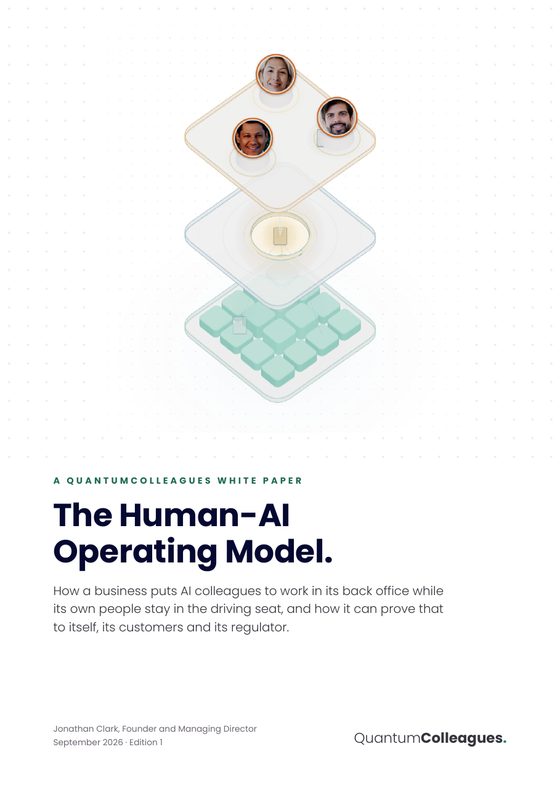
01 Your people
Named, accountable, and still in charge. Anything with consequence comes to a person, and the record shows who. Deciding is a lighter job than doing, so their time goes on judgement.
02 The approval gate
A rule, not a person: anything with consequence stops here. It is written down before go live, agreed with the people who sit at it, and it is not a setting the AI can change. No colleague holds the send button.
03 AI colleagues
One coordinated set of agents. They read, sort, draft, look things up in your own policies and answer with citations, keep the log, and produce the daily report. They prepare and they never decide.
The consequence test
How you decide what crosses the gate.
Ask one question of each kind of work: if this went wrong, who would have to put it right, and could they? If the honest answer is a person, a customer or a regulator, it stops at the gate. If the colleague would simply do it again correctly, it stays below.
The threshold model
What each colleague may and may not do on its own.
For every kind of work a colleague handles, its permissions are written down in plain English before it goes live, agreed with the business, held outside the model, and enforced by the platform on every action. A prompt that says "be careful" is not a control, because a control only counts if it holds without the AI's cooperation.
A colleague starts cautious. As it proves itself, the business can widen what it does alone. If it gets something wrong in a way the system can verify, its permission for that kind of work narrows at once and a person is told. Widening it again is a human decision, never an automatic one.
Every action is logged with what it did, why, what it relied on, and who approved it. That is what we mean by auditable by design. It is designed to support what your sector's regulator expects, rather than to claim compliance on your behalf.
What this makes possible
Run AI this way and the good reaches further than one back office.
Your organisation flourishes
You gain capacity without headcount. The back office runs, the owners get their time back for the work only people can do, and the business can take on more without stretching the team thin.
Your people are amplified
Their day fills with judgement instead of drudgery. They learn to run the system alongside our advisers, so you own the capability rather than rent a contract, and the work itself gets better.
The wider ecosystem grows
Small organisations that adopt AI safely give the people in them a firmer footing. Our profits then fund free post-AI training and career planning, so the good reaches people well beyond the firms that take it up.
The white paper
Ten pages. The model, the consequence test, a week in the back office, how to get started, and ten questions to ask anyone offering you AI for your business.
Leave your name and email and we will send it to you. We use your details only to send the paper and to reply if you write back.
✓ Request received
Thank you. We reply personally with the paper, usually the same day.
Why we do it this way
QuantumColleagues is half owned by an asset locked community interest company. SMEs and regulated businesses buy our AI products and advisory services, and the profits then fund free post-AI training and career planning for people from every walk of life. So when we say people decide, we mean it twice over. Read the mission → Admin Core, this model as a product → Advisory, learn to run it yourselves →